Search


Sunday, March 11, 2018

Key points of PCR

Key points:

  • Polymerase chain reaction, or PCR, is a technique to make many copies of a specific DNA region in vitro (in a test tube rather than an organism).
  • PCR relies on a thermostable DNA polymerase, Taq polymerase, and requires DNA primers designed specifically for the DNA region of interest.
  • In PCR, the reaction is repeatedly cycled through a series of temperature changes, which allow many copies of the target region to be produced.
  • PCR has many research and practical applications. It is routinely used in DNA cloning, medical diagnostics, and forensic analysis of DNA.

What is PCR?

Polymerase chain reaction (PCR) is a common laboratory technique used to make many copies (millions or billions!) of a particular region of DNA. This DNA region can be anything the experimenter is interested in. For example, it might be a gene whose function a researcher wants to understand, or a genetic marker used by forensic scientists to match crime scene DNA with suspects.
Typically, the goal of PCR is to make enough of the target DNA region that it can be analyzed or used in some other way. For instance, DNA amplified by PCR may be sent for sequencing, visualized by gel electrophoresis, or clonedinto a plasmid for further experiments.
PCR is used in many areas of biology and medicine, including molecular biology research, medical diagnostics, and even some branches of ecology.

Taq polymerase

Like DNA replication in an organism, PCR requires a DNA polymerase enzyme that makes new strands of DNA, using existing strands as templates. The DNA polymerase typically used in PCR is called Taq polymerase, after the heat-tolerant bacterium from which it was isolated (Thermus aquaticus).
T. aquaticus lives in hot springs and hydrothermal vents. Its DNA polymerase is very heat-stable and is most active around 70°C (a temperature at which a human or E. coli DNA polymerase would be nonfunctional). This heat-stability makes Taq polymerase ideal for PCR. As we'll see, high temperature is used repeatedly in PCR to denature the template DNA, or separate its strands.

PCR primers

Like other DNA polymerases, Taq polymerase can only make DNA if it's given a primer, a short sequence of nucleotides that provides a starting point for DNA synthesis. In a PCR reaction, the experimenter determines the region of DNA that will be copied, or amplified, by the primers she or he chooses.
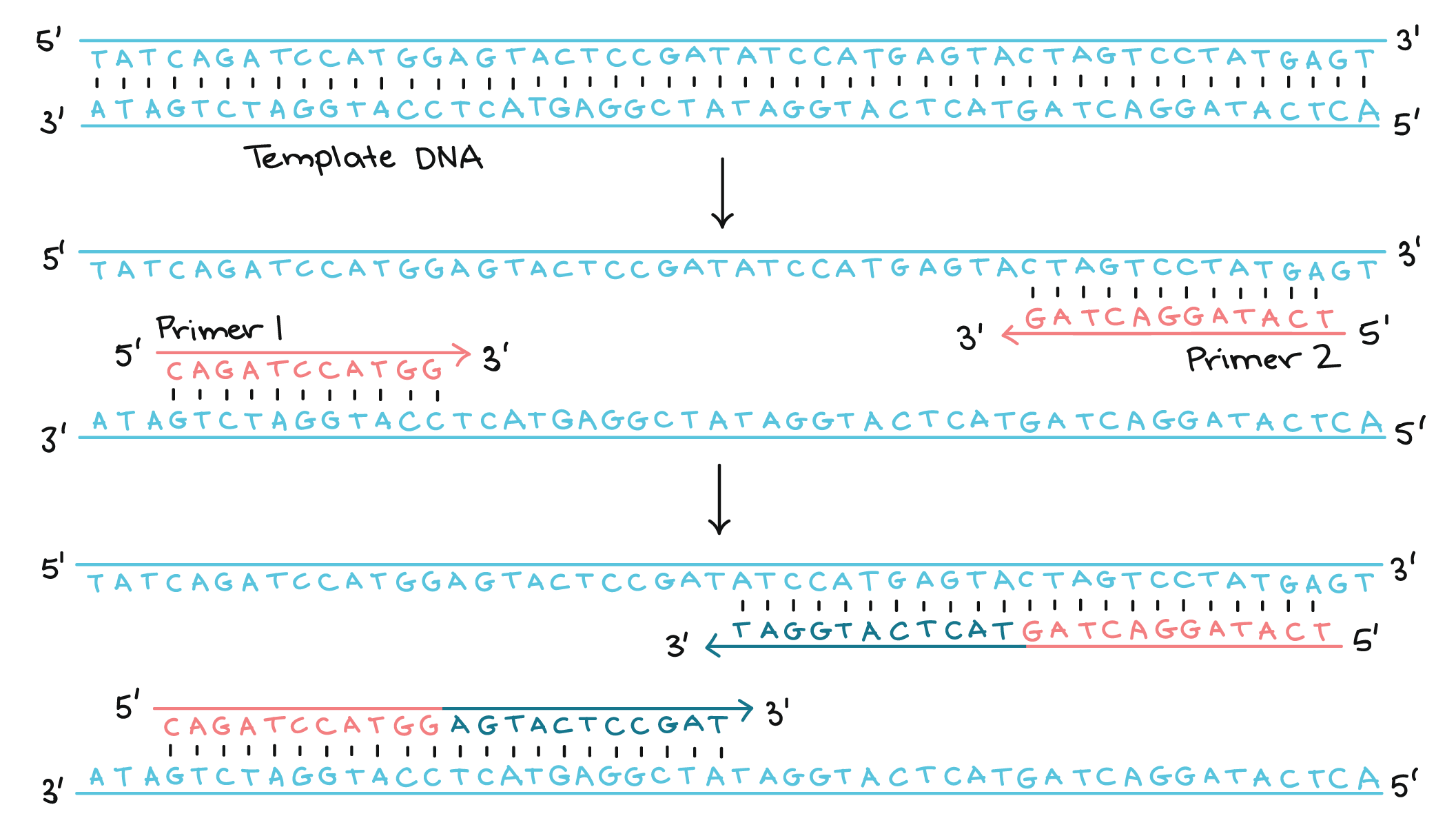
PCR primers are short pieces of single-stranded DNA, usually around 20nucleotides in length. Two primers are used in each PCR reaction, and they are designed so that they flank the target region (region that should be copied). That is, they are given sequences that will make them bind to opposite strands of the template DNA, just at the edges of the region to be copied. The primers bind to the template by complementary base pairing.

Template DNA:
5' TATCAGATCCATGGAGT...GAGTACTAGTCCTATGAGT 3' 3' ATAGTCTAGGTACCTCA...CTCATGATCAGGATACTCA 5'
Primer 1: 5' CAGATCCATGG 3' Primer 2:
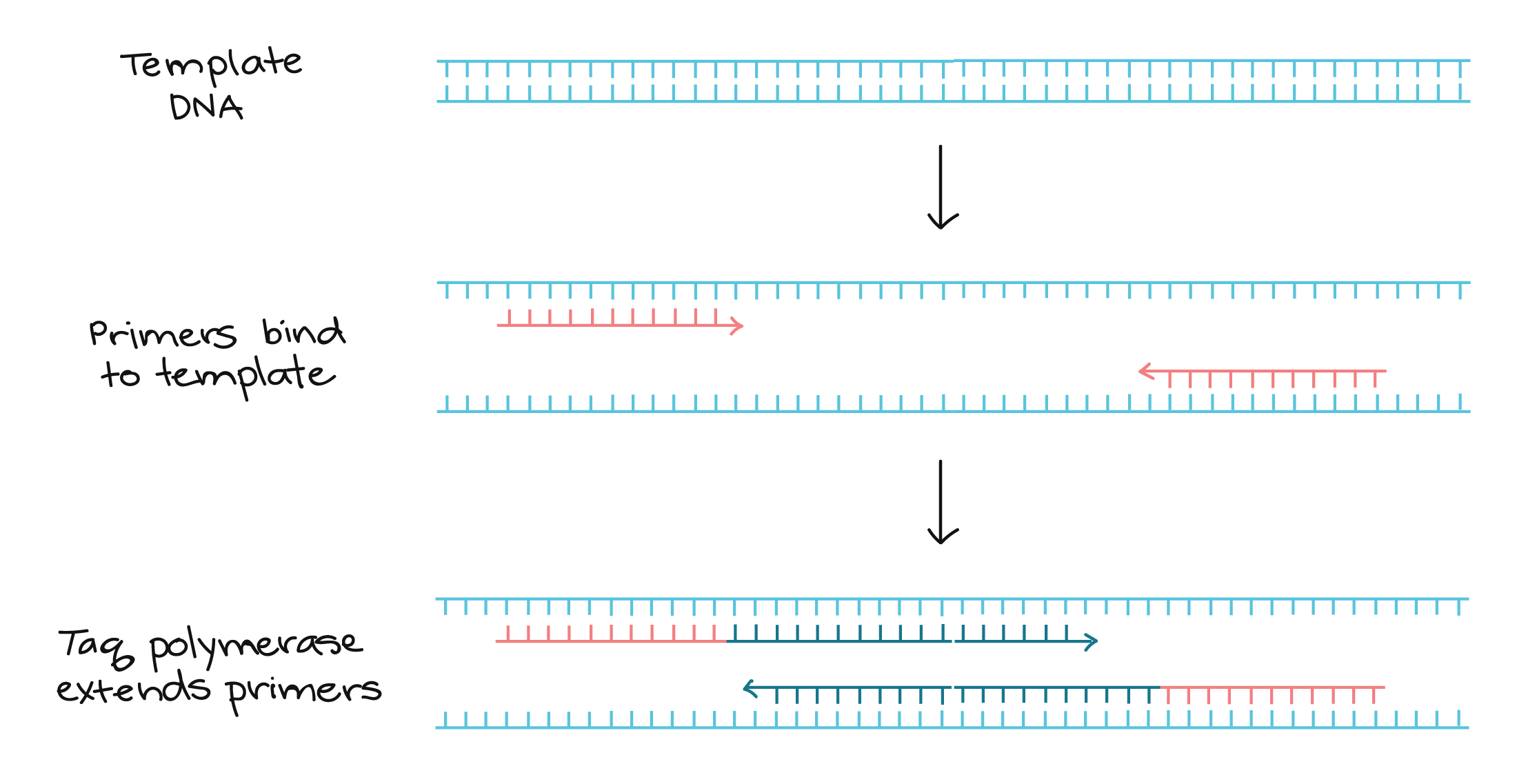
When the primers are bound to the template, they can be extended by the polymerase, and the region that lies between them will get copied.
The steps of PCR

The key ingredients of a PCR reaction are Taq polymerase, primers, template DNA, and nucleotides (DNA building blocks). The ingredients are assembled in a tube, along with cofactors needed by the enzyme, and are put through repeated cycles of heating and cooling that allow DNA to be synthesized.
The basic steps are:
  1. Denaturation (96°C): Heat the reaction strongly to separate, or denature, the DNA strands. This provides single-stranded template for the next step.
  2. Annealing (55 - 65°C): Cool the reaction so the primers can bind to their complementary sequences on the single-stranded template DNA.
  3. Extension (72°C): Raise the reaction temperatures so Taq polymerase extends the primers, synthesizing new strands of DNA.
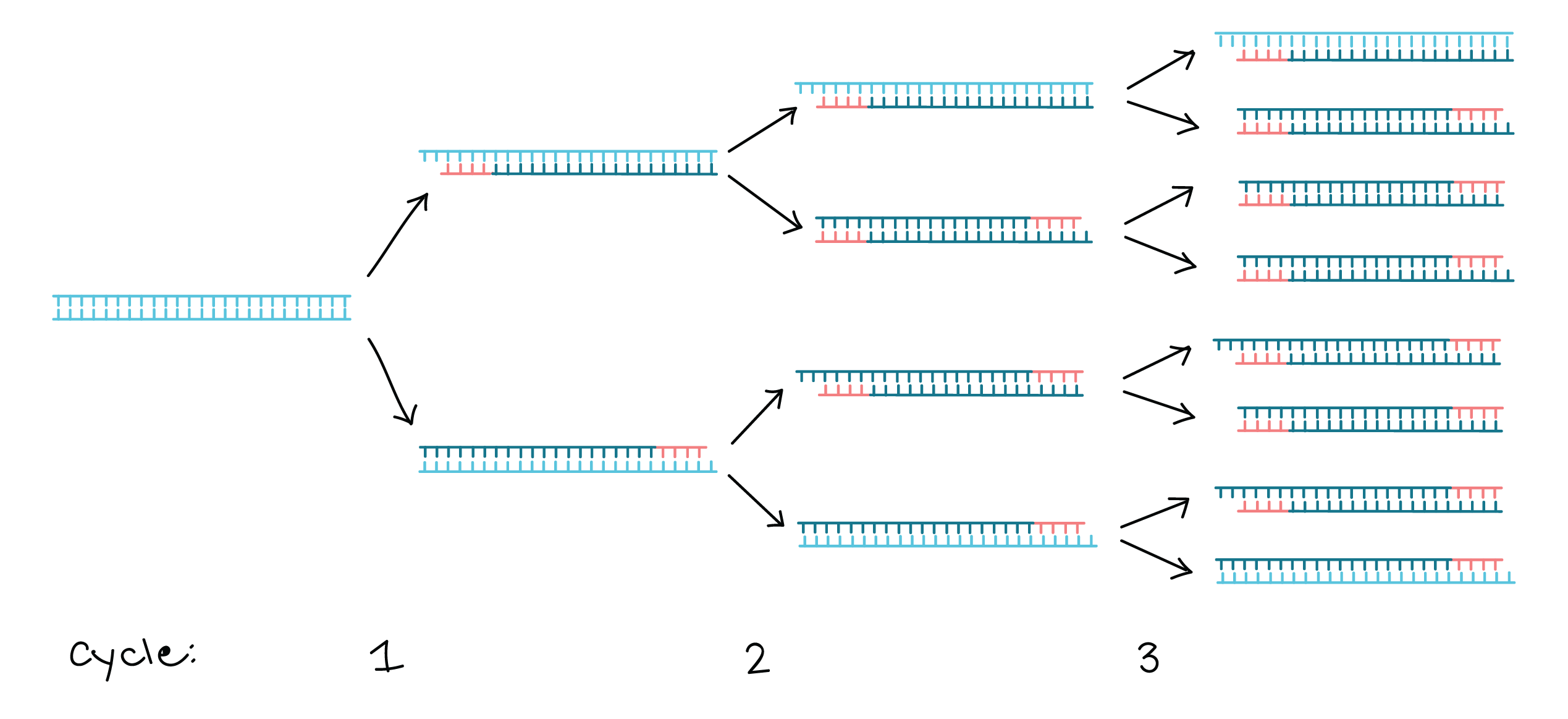
This cycle repeats 25 - 35 times in a typical PCR reaction, which generally takes 2 - 4 hours, depending on the length of the DNA region being copied. If the reaction is efficient (works well), the target region can go from just one or a few copies to billions.
That’s because it’s not just the original DNA that’s used as a template each time. Instead, the new DNA that’s made in one round can serve as a template in the next round of DNA synthesis. There are many copies of the primers and many molecules of Taq polymerase floating around in the reaction, so the number of DNA molecules can roughly double in each round of cycling. This pattern of exponential growth is shown in the image below.
Using gel electrophoresis to visualize the results of PCR

The results of a PCR reaction are usually visualized (made visible) using gel electrophoresis. Gel electrophoresis is a technique in which fragments of DNA are pulled through a gel matrix by an electric current, and it separates DNA fragments according to size. A standard, or DNA ladder, is typically included so that the size of the fragments in the PCR sample can be determined.
DNA fragments of the same length form a "band" on the gel, which can be seen by eye if the gel is stained with a DNA-binding dye. For example, a PCR reaction producing a 400 base pair (bp) fragment would look like this on a gel:

Left lane: DNA ladder with 100, 200, 300, 400, 500 bp bands.
Right lane: result of PCR reaction, a band at 400 bp.
A DNA band contains many, many copies of the target DNA region, not just one or a few copies. Because DNA is microscopic, lots of copies of it must be present before we can see it by eye. This is a big part of why PCR is an important tool: it produces enough copies of a DNA sequence that we can see or manipulate that region of DNA.

Applications of PCR

Using PCR, a DNA sequence can be amplified millions or billions of times, producing enough DNA copies to be analyzed using other techniques. For instance, the DNA may be visualized by gel electrophoresis, sent for sequencing, or digested with restriction enzymes and cloned into a plasmid.
PCR is used in many research labs, and it also has practical applications in forensics, genetic testing, and diagnostics. For instance, PCR is used to amplify genes associated with genetic disorders from the DNA of patients (or from fetal DNA, in the case of prenatal testing). PCR can also be used to test for a bacterium or DNA virus in a patient's body: if the pathogen is present, it may be possible to amplify regions of its DNA from a blood or tissue sample.

Sample problem: PCR in forensics

Suppose that you are working in a forensics lab. You have just received a DNA sample from a hair left at a crime scene, along with DNA samples from three possible suspects. Your job is to examine a particular genetic marker and see whether any of the three suspects matches the hair DNA for this marker.
The marker comes in two alleles, or versions. One contains a single repeat (brown region below), while the other contains two copies of the repeat. In a PCR reaction with primers that flank the repeat region, the first allele produces a 200 b, p DNA fragment, while the second produces a 300 b, p DNA fragment:

Marker allele 1: primers flanking repeat region amplify a 200 bp fragment of DNA
Marker allele 2: primers flanking repeat region amplify a 300 bp fragment of DNA
You perform PCR on the four DNA samples and visualize the results by gel electrophoresis, as shown below:
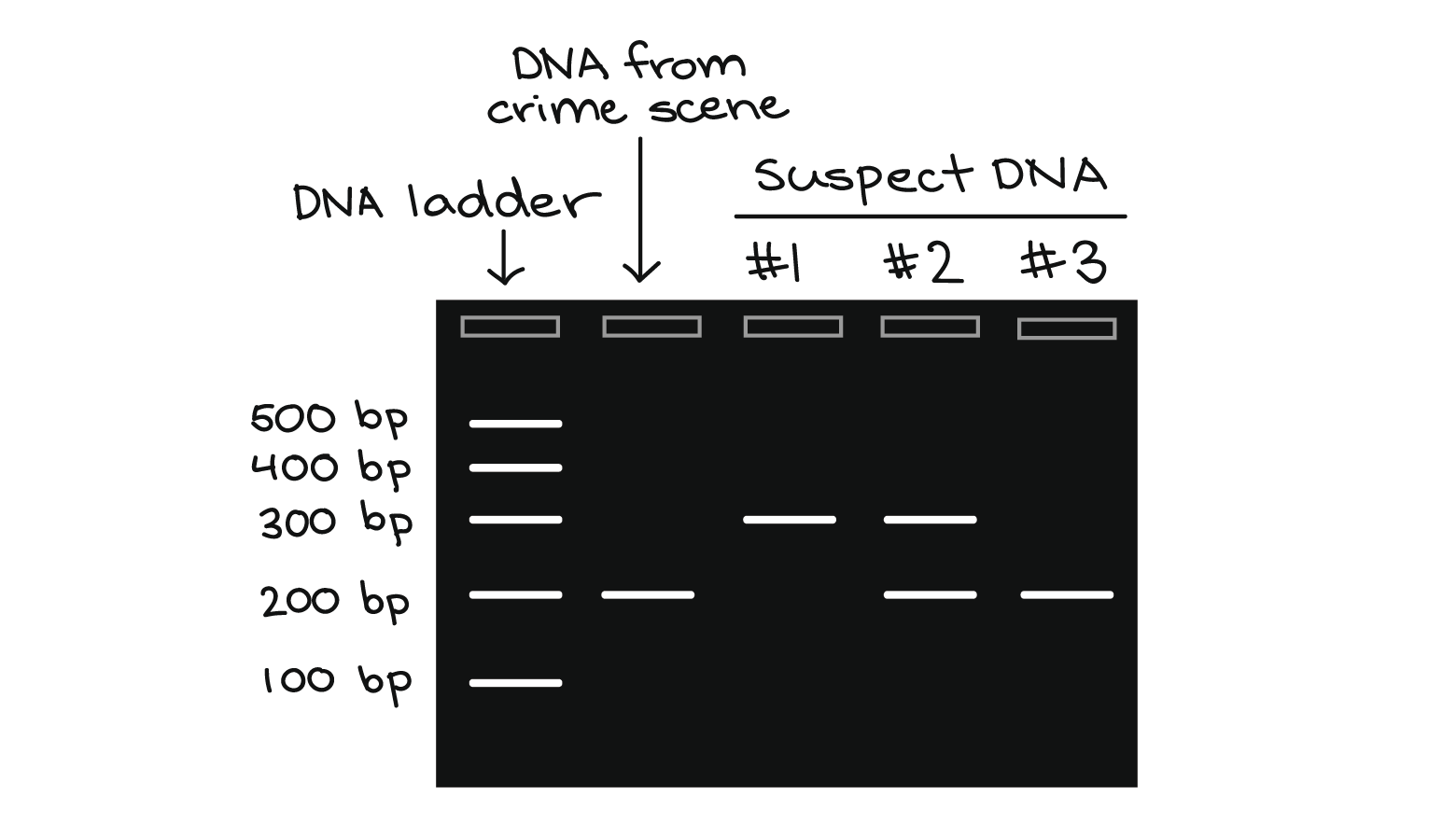
The gel has five lanes:
First lane: DNA ladder with 100, 200, 300, 400, and 500 bp bands.
Second lane: DNA from crime scene, 200 bp band.
Third lane: Suspect #1 DNA, 300 bp band.
Fourth lane: Suspect #2 DNA, 200 and 300 bp bands.
Fifth lane: Suspect #3 DNA, 200 bp band.
Which suspect's DNA matches the DNA from the crime scene at this marker?
Choose 1 answer:

More about PCR and forensics

In real forensic tests of DNA from a crime scene, technicians would do an analysis conceptually similar to the one in the example above. However, a number of different markers (not just the single marker in the example) would be compared between the crime scene DNA and the suspects' DNA.
Also, the markers used in a typical forensic analysis don't come in just two different forms. Instead, they're highly polymorphic (poly = many, morph = form). That is, they come in many alleles that vary in tiny increments of length.
The most commonly used type of markers in forensics, called short tandem repeats (STRs), consist of many repeating copies of the same short nucleotide sequence (typically, 2 to 5 nucleotides long). One allele of an STR might have 20 repeats, while another might have 18, and another just 10start superscript, 1, end superscript.
By examining multiple markers, each of which comes in many allele forms, forensic scientists can build a unique genetic "fingerprint" from a DNA sample. In a typical STR analysis using 13 markers, the odds of a false positive (two people having the same DNA "fingerprint") are less than 1 in 10 b, i, l, l, i, o, nstart superscript, 1, end superscript!
Although we may think of DNA evidence being used to convict criminals, it has played a crucial role in exonerating falsely accused people (including some who had been jailed for many years). Forensic analysis is also used to establish paternity and to identify human remains from disaster scenes.

Weaknesses of Polymerase Chain Reaction

There are some drawbacks of using PCR that one should be aware of as well. First, if you are wanting to amplify a specific gene, you will need some knowledge of the gene’s DNA sequence in order to properly design some primers. In this case, specific primers are used so that amplificationof only the gene takes place, rather than random areas of the chromosome. There may also be a need to optimize concentrations of each chemical component. For example changing the amount of DNA template, MgCl2 and Taq polymerase can affect both the quantity and quality of bands produced. Some studies have shown that even the brand of Taq polymerase can affect results (Holden et al. 2003). Likewise the temperature cycles may need adjusted. 

When PCR was originally developed, DNA fragments in the range of 100 - 500 bp could be copied. Now there are modifications which allow successful PCR for DNA fragments up to 5 kb, but any larger and the reaction becomes less efficient (Barnes 1994; Cheng et al. 1994). There are reports of long extension PCR with fragments of as large as 42 kb being amplified, but these types of reactions are not yet routine (Barnes 1994; Cheng et al. 1994). Therefore, PCR is currently limited to copying only parts of genes or other DNA clones.

Strengths of PCR

A couple of PCR’s strengths are that it is a simple procedure to set up and run, and requires only small amounts of starting DNA samples. It is now possible to get enough DNA to conduct a PCR analysis from merely a paper hole punch size of leaf tissue. Even just one human hair contains enough DNA, making PCR useful in forensics. Another advantage of PCR is that it is a very quick procedure. In as little as 2 hours, millions of copies of DNA can be made. Automation and robotic assistance are now available which allow the processing of many samples in a very short time. In a context such as plant breeding, this would mean that many individual plants can be sampled by simply collecting a small leaf tissue. They could then be 'PCRed' to screen for the presence of a particular gene of interest. Only those testing positive would be kept for the next plant breeding stage. For example, an automated PCR would make it simple to keep only those plants with a transgene after a backcross. See Lesson: Real Time PCR - Some Basic Principles.

The discovery of PCR

In 1983 a scientist by the name of Kary Mullis was driving along a Californian mountain road late one night and formulated a revolutionary way to make laboratory copies of DNA molecules (Saiki et al. 1985, Mullis 1990). The resulting polymerase chain reaction, or PCR for short, probably first became known to the general American public in its forensics use during the 1995 O.J. Simpson trial. In general PCR is sort of like making a genetic photocopy of a section of a chromosome.

This laboratory technique is modeled after a living cell’s natural ability to replicate (make copies of) DNA during normal cell cycles. Every living cell makes a duplicate copy of each chromosome during the early stage of cell division known as interphase.


In the following mitotic stages, one copy of each chromosome is pulled toward a respective pole when 2 cells are formed (see lesson Mitosis and Meiosis and the Cell Cycle). This replication process also occurs similarly in the beginning stages of gamete formation during meiosis. The general idea of DNA replication is that the double-stranded DNA molecule unwinds and partially splits into 2 single strands. 

Various proteins interact to stabilize it and catalyze the formation of a complementary strand for each of the original single strands. A short RNA primer sequence is made first, followed by the enzyme DNA polymerase connecting new nucleotides to this primer, until the entire chromosome has been replicated. The details will be explained shortly. Figure: DNA replication illustrates the process in a cell.

Chemical Components of PCR

Let’s now take a look at what the name 'Polymerase Chain Reaction' describes in order to better understand the details of the process. 'Polymerase' is chosen because PCR makes use of a DNA polymerase enzyme for constructing new DNA strands, just like in a living cell. 'Chain Reaction' is also used because this technique involves repeating different heating and cooling cycles over and over again, as many as 35 or more times. Each complete cycle doubles the amount of DNA present, so in just 20 cycles there are over one million (220) copies of that specific segment of DNA . For PCR there are five chemical components needed, including a DNA template, DNA polymerase enzyme, primers, nucleotides and reaction buffer. These are described here in detail. 

1. The DNA template is that particular DNA sequence which you want copied. 

2. There are two requirements for a suitable DNA polymerase enzyme for PCR. First, one is needed that has a good activity rate around 75°C. Second, it should be able to withstand temperatures of 95-100°C so that more enzyme does not have to be added at the beginning of each new cycle. The first to be discovered with these characteristics was Taq polymerase, isolated from Thermus aquaticus, a thermophilic eubacterium found in hot springs (Chien et al. 1976). Naturally coming from a hot environment, it does not easily denature in the hot temperatures required in PCR; plus it has a good efficiency, able to add 60 base pairs/sec at 70°C. Like all other DNA polymerases, Taq cannot begin DNA replication without the addition of a starting primer

3. Primers are short oligonucleotides of DNA, usually around 8-60 base pairs in length. They can be random sequences if the project’s goal is for general genomic studies. However, if the purpose is to amplify a certain section of DNA in the genome, such as a known gene, then primers of specific sequences must be used. 

4. The four different deoxyribonucleotide triphosphates (dNTPs), adenine (A), guanine (G), cytosine (C), and thymine (T) are needed to provide the building blocks for DNA replication. DNA polymerase will add each complementary base to the new growing DNA strand according to the original strand’s sequence following normal A-T and C-G pairings. 

5. Finally, a reaction buffer is used to provide a stable pH. It may also contain magnesium chloride, if not, then MgCl2 must be added separately. Mg2+ plays a vital role in the PCR reaction, acting as a co-factor for Taq polymerase and thereby influencing enzyme activity.

Bioprotocols of Real Time PCR

Refer to: